



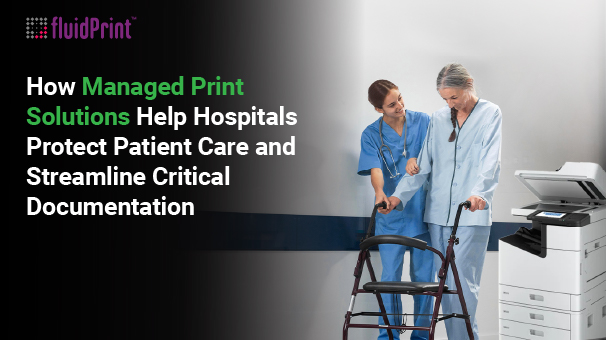
Managed print solutions for hospitals address one of the most overlooked operational challenges in healthcare: the safe, reliable, and compliant handling of patient documentation at scale. Hospitals depend on printed records at every stage of care, from admission and diagnosis through to discharge and billing, making the print environment a direct contributor to both patient safety and operational efficiency.
This article covers how managed print solutions help hospitals protect patient data, reduce documentation bottlenecks, and give healthcare teams more time to focus on care rather than print-related issues.
The Growing Challenge of Patient Documentation in Hospitals
Hospitals operate in a fast-paced environment where timely access to accurate patient information is essential. Yet documentation challenges remain common across many healthcare facilities.
Some of the most common issues hospitals face include:
1. High Volume of Documents
Hospitals generate a significant volume of documents daily, including:
- Patient admission forms
- Medical histories
- Lab reports
- Diagnostic imaging reports
- Prescriptions
- Discharge summaries
- Insurance documentation
Managing these documents across departments such as emergency, pharmacy, radiology, and administration can be complex and time-consuming.
2. Fragmented Printing Infrastructure
Many hospitals operate with multiple printers and copiers from different vendors across departments. These devices are often unmanaged, leading to:
- Device downtime
- High maintenance costs
- Inconsistent performance
- Lack of centralized control
3. Security Risks
Patient records contain highly sensitive data. When printing systems lack proper controls, hospitals risk:
- Unauthorized access to patient information
- Data breaches
- Compliance violations
4. Inefficient Workflows
In many hospitals, staff members spend valuable time searching for printers, waiting for print jobs, or manually handling documents. These inefficiencies reduce productivity and divert attention away from patient care.
These are precisely the challenges that healthcare managed print services are designed to address. By bringing all print devices under a single, centrally managed system, hospitals can tackle security, workflow, and cost issues simultaneously.
What Are Managed Print Solutions?
Managed print solutions are services that help organizations optimize, monitor, and manage their entire printing infrastructure.
Instead of dealing with scattered printers and manual processes, hospitals can implement a centralized system that:
- Monitors all printing devices
- Automates document workflows
- Reduces operational costs
- Improves document security
- Ensures reliable printing across departments
Healthcare-focused providers like Wepsol design managed print services for healthcare that specifically address the unique challenges faced by hospitals and healthcare organizations. To understand how managed print fits within a broader document strategy, see Wepsol’s managed print services overview.
How Managed Print Solutions Streamline Patient Documentation?
1. Centralized Print Management Across Departments
Hospitals often have dozens or hundreds of printers spread across departments. Managed print solutions for hospitals bring all these devices under one centralized management system. This allows IT teams to:
- Monitor printer performance
- Track usage across departments
- Automatically manage supplies like toner and paper
- Detect issues before devices fail
This centralized visibility helps hospitals maintain uninterrupted printing operations, which is critical when handling patient documentation.
2. Faster Access to Patient Documents
In healthcare, time is critical. Doctors and nurses need quick access to patient documents to make informed decisions.
Healthcare print solutions enable faster document access through:
- Secure pull printing
- Mobile printing
- Cloud-based document access
- Integration with hospital information systems
A doctor can send a print job and retrieve it securely from the nearest printer using authentication. This eliminates delays and ensures patient information is available when needed.
3. Improved Security for Patient Data
Healthcare organizations must comply with strict regulations regarding patient data protection.
Traditional printing environments often create security risks such as:
- Documents left unattended on printers
- Unauthorized access to printed files
- Unsecured network printers
Managed print services for healthcare address these challenges through advanced security features including:
- User authentication before printing
- Encrypted print jobs
- Secure document release
- Access control policies
By implementing secure printing for hospitals, healthcare facilities can protect sensitive patient information while maintaining compliance with healthcare regulations. The U.S. Department of Health & Human Services HIPAA Security Rule outlines the administrative and technical safeguards applicable to protected health information.
4. Reduced Administrative Burden for Healthcare Staff
Healthcare professionals already deal with demanding workloads. Administrative tasks such as document handling should not add additional stress, as they can detract from the time healthcare professionals spend on patient care and other critical responsibilities.
Managed print solutions automate many routine processes, including:
- Document routing
- Printing workflows
- Supply management
- Device monitoring
This allows nurses, doctors, and administrative staff to focus more on patient care rather than dealing with printing issues.
Hospitals that implement optimized printing workflows often see significant improvements in staff productivity, which can lead to quicker turnaround times for diagnostic reports and better overall patient care.
5. Streamlined Lab and Diagnostic Reporting
Diagnostic reports are among the most critical documents in healthcare. From blood test results to imaging reports, these documents must be printed quickly and accurately for doctors to review.
Managed print solutions for hospitals help streamline diagnostic reporting by:
- Ensuring high-speed printing for lab reports
- Reducing printing errors
- Automating report distribution to departments
- Maintaining consistent document quality
This ensures that doctors receive diagnostic information promptly, supporting better patient outcomes.
6. Cost Control and Operational Efficiency
Printing costs in hospitals can grow significantly due to:
- Excessive printing
- Unmonitored device usage
- Expensive maintenance
- Inefficient device placement
Print management for healthcare organizations helps hospitals control costs through:
- Usage monitoring and analytics
- Optimized device placement
- Automatic supply management
- Reduced energy consumption
By analyzing print usage patterns, hospitals can eliminate unnecessary devices and reduce waste. Research by Gartner on managed print services consistently identifies print cost reduction as a primary driver for adopting managed print in institutional settings.
7. Reliable Printing During Critical Situations
Healthcare environments cannot afford printer downtime. During emergencies, hospitals rely on printing for:
- Emergency admission forms
- Medication instructions
- Patient records
- Critical reports
Healthcare managed print services provide proactive monitoring that detects issues before they cause downtime. Automated alerts and remote troubleshooting ensure printers remain operational at all times. This reliability is essential for hospitals that depend on consistent document availability.
Real Impact: How Hospitals Benefit from Managed Print Solutions
Hospitals that implement managed print solutions often experience measurable improvements across several areas.
Some of the key benefits include:
- Increased Productivity
Doctors and nurses spend less time managing documents and more time focusing on patient care. - Improved Patient Experience
Faster document processing reduces waiting times for patients. - Enhanced Security
Secure printing systems protect sensitive patient data from unauthorized access. - Reduced Costs
Hospitals lower operational expenses through optimized print management. - Simplified IT Management
Centralized monitoring reduces the burden on IT teams.
These benefits make managed print services for healthcare providers a vital enabler of critical operations, supporting efficiency, security, and patient care delivery. To see how managed print solutions apply across institutional settings, explore Wepsol’s print solutions for enterprises.
The Role of Smart Printing in Healthcare Digital Transformation
Digital adoption is a major focus in healthcare today. Hospitals are implementing technologies such as:
- Electronic Health Records
- Telemedicine
- AI-powered diagnostics
- Cloud-based healthcare systems
However, printed documents still play a vital role in clinical workflows, particularly in clinical handovers, patient consent, prescription management, and regulatory submissions.
Healthcare managed print services bridge the gap between digital systems and physical documentation by integrating printing with digital healthcare platforms. This ensures seamless information flow between electronic and printed records.
For a relevant industry perspective, Healthcare IT News covers how print management integrates with health IT strategy.
Wepsol’s solutions are designed to support hospitals in this transition by combining advanced printing technology with intelligent document management in hospitals.
Why Healthcare Facilities Should Prioritize Managed Print Solutions
As patient volumes increase and healthcare systems grow more complex, hospitals must adopt smarter operational strategies.
Managed print solutions for hospitals offer a practical way to:
- Simplify document workflows
- Improve operational efficiency
- Protect patient data
- Reduce administrative burdens
- Control printing costs
The case comes down to three fundamentals: security, reliability, and cost.
- Security: Unmanaged print devices are a known vector for data breaches. HIPAA-aligned secure printing for hospitals controls reduce that risk substantially.
- Reliability: Proactive monitoring and maintenance prevents the downtime that disrupts care workflows at the worst possible moment.
- Cost: Consolidated managed print services for healthcare replace fragmented vendor relationships with a single, accountable partner and a predictable cost model.
For hospitals evaluating providers, the ISO/IEC 15408 standard for IT security evaluation provides a useful framework for assessing the security credentials of print management solutions.
How Wepsol Supports Hospitals with Managed Print Solutions?
Healthcare organizations need technology partners who understand the challenges of hospital environments.
Wepsol provides advanced managed print solutions for hospitals designed specifically for healthcare institutions. Their solutions help hospitals:
- Optimize printing infrastructure
- Ensure secure document management
- Automate workflows
- Reduce operational costs
- Improve efficiency across departments
With expertise in enterprise printing and document management, Wepsol helps hospitals build reliable, secure, and cost-controlled document ecosystems that support patient care at every level. To learn more, visit the Wepsol solutions page or get in touch with the team.
Final Thoughts
Patient documentation is an essential part of healthcare delivery. From admissions and prescriptions to diagnostic reports and discharge summaries, hospitals depend on reliable document workflows to keep care moving efficiently.
Fragmented, unmanaged, or unreliable printing environments introduce operational friction that healthcare professionals cannot afford. Device downtime, security vulnerabilities, and inefficient workflows divert valuable time and attention away from what matters most: patient care.
Managed print solutions for hospitals provide a structured way to manage documents by centralizing print infrastructure, automating workflows, and improving security across every department.
In a healthcare environment where every second matters, the way a hospital manages its print environment has a direct bearing on care delivery.
If your hospital is looking to simplify document workflows, strengthen patient data security, and ensure uninterrupted access to critical records, contact Wepsol’s team to find out how your current printing environment can be optimized to better support patient care.
Frequently Asked Questions
What are managed print solutions for hospitals?
Managed print solutions for hospitals are services where a specialist provider manages the entire print environment, including devices, maintenance, security, and supplies, under a single service agreement.
How do managed print services support HIPAA compliance?
They protect patient information through user authentication, encrypted print jobs, pull printing, and access controls that align with HIPAA Security Rule requirements for physical document safeguarding.
How do managed print solutions reduce hospital printing costs?
Through device consolidation, automated supply management, usage analytics, and proactive maintenance that replaces unpredictable print expenditure with a controlled cost structure.
Can managed print solutions integrate with hospital information systems?
Yes. They integrate with Electronic Health Record platforms and clinical document management systems, enabling automatic document routing, reduced manual handling, and compliance audit trails.
What should hospitals look for in a managed print services provider?
Healthcare experience, HIPAA-compliant secure printing, strong SLA commitments, broad device support, and the ability to integrate with existing clinical systems. Contact Wepsol to discuss your hospital’s requirements.