


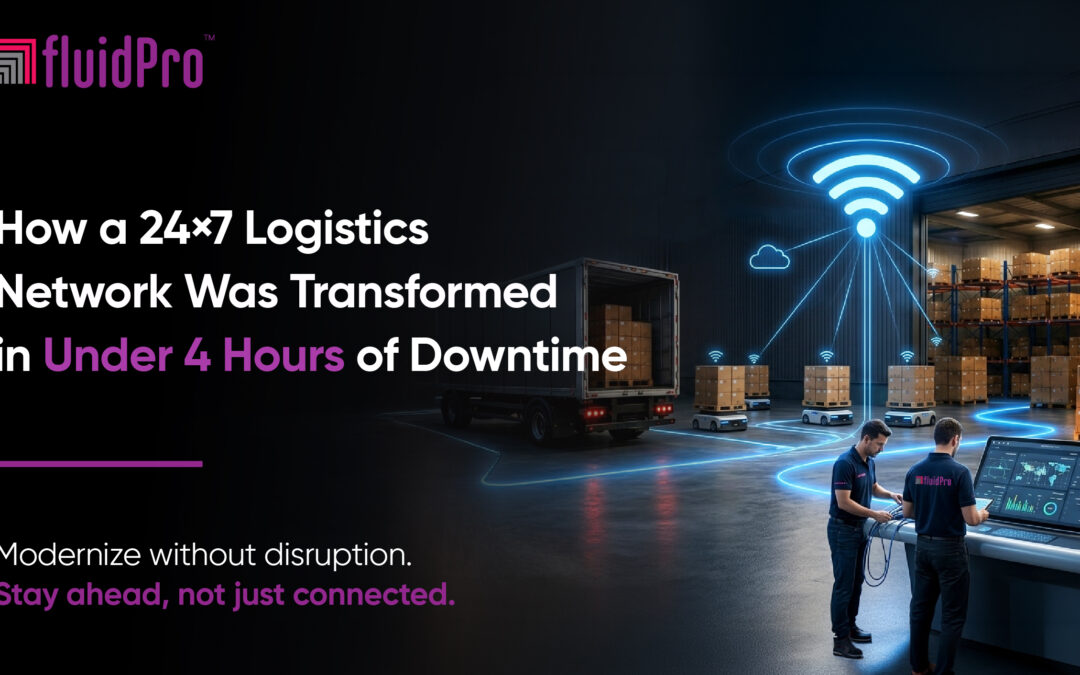
In logistics, time isn’t just money -it’s momentum. Project “Setu” establishes that modernization doesn’t happen at the cost of disruption.
| < 4 hrs | 3 phases | Wi-Fi 6 |
|---|---|---|
| Total downtime across the entire upgrade over 2 weeks. | Managed Project Delivery (Plan → Deploy → Handover) | Enterprise-grade wireless, zero dead zones |
When infrastructure holds you back
At first glance, everything appeared to be operating as expected. In the aviation industry, where precision, speed, and reliability are non-negotiable, critical components were moving on schedule, customer commitments were being met, and daily operations continued seamlessly. But behind the scenes, the IT infrastructure was struggling to keep pace with the demands of a growing business. Years of incremental upgrades had resulted in a fragmented network-built on legacy switches, inconsistent wireless coverage, and unstructured cabling-creating an environment that was increasingly difficult to manage, secure, and scale.
The consequences extended far beyond IT. Network latency slowed access to business-critical applications, inconsistent connectivity disrupted operational workflows, and limited infrastructure visibility left IT teams responding to issues rather than preventing them. The absence of network segmentation increased security risks, while the lack of a dedicated infrastructure environment exposed critical networking equipment to unnecessary operational vulnerabilities. In the aviation industry, where every second can impact service delivery and customer commitments, these weren’t just technology challenges-they were obstacles to operational efficiency, business continuity, and future growth.
“Technology should keep cargo moving, not become the reason it slows down”
The constraint: transform without stopping
The client needed a complete infrastructure overhaul. The catch? It had to happen inside a live, always-on environment, with less than four hours of total downtime and no dedicated server room to work from. Traditional approaches shutdown, replace, restart – simply was not working. Even short disruptions would cause ripples across the supply chain.
FluidPro (WEP Solutions Limited) took a fundamentally different approach: Transform Without Interrupting Operations. Instead of ripping out the old network and racing to replace it, they constructed the new system in parallel with the existing one, then transitioned seamlessly.
Execution in three phases
PHASE 1
Passive setup -zero downtime
A new structured cabling system was installed alongside the live network. Every cable was tested, labeled, and certified. Operations continued without a single interruption -steady progress happening entirely in the background.
PHASE 2
Active pre-staging
All devices -switches, access points, configurations -were set up offline in advance, including VLAN configurations, enterprise-grade security policies, and QoS settings to prioritize critical applications. By the end of this phase, the new network was essentially built and tested. It just wasn’t live yet.
PHASE 3
Live cutover – under 4 hours
Migration was scheduled across two weekends and executed floor by floor, with each cutover completed in 30–45 minutes and validated immediately after. If anything went wrong at one step, it could be contained without affecting the rest of the operation. Everything worked perfectly.
Solving the server room problem
One of the most daunting challenges was the lack of a proper server environment. A traditional server room requires dedicated space, cooling, power backup, and physical security, none of which were readily available on-site.
Rather than forcing a conventional solution, FluidPro introduced a compact N-POD micro data center: an all-in-one unit with integrated cooling, built-in UPS for power continuity, biometric access control, and IP-based monitoring. It delivered full server room functionality without requiring additional space or infrastructure changes. A constraint became an advantage.
What the network looks like now
The rebuilt infrastructure follows a modern three-tier architecture -a high-availability core layer for speed and resilience, a managed PoE distribution layer for efficient power and data delivery, and a Wi-Fi 6 access layer that eliminated every dead zone in the facility. VLAN-based segmentation sharpened both security and performance. QoS prioritization ensures critical applications always get bandwidth when they need it. And for the first time, the IT team has full real-time visibility across the entire network.
“The network evolved into an intelligent, resilient foundation that actively supports business growth.”
One Solution. Every Layer Protected. Zero Disruption.
Most organizations know they need to modernize. What holds them back isn’t the technology – it’s the fear of what happens in between: the downtime, the missteps, the risk of getting it wrong in a world that never pauses. That fear is valid. But Project Setu proved it doesn’t have to be the deciding factor.
Real transformation isn’t a single event – it’s a layered, deliberate evolution that addresses every dimension of your infrastructure. The physical security that safeguards your people, premises, and assets. The control tools that give your teams live visibility and the authority to act. The power protection that keeps operations running even when the grid doesn’t cooperate. And the cybersecurity framework that ensures threats never make it anywhere near your core systems.
When these elements are planned together, phased intelligently, and sequenced with purpose – modernization stops feeling like a gamble and starts feeling like progress. Not a disruption to manage, but a transformation to own. The key, as always, wasn’t just the technology. It was the mindset – and the discipline to execute it right.
Modernize without disruption. Secure every layer. Stay ahead, not just connected.
Frequently Asked Questions
How can enterprises upgrade network infrastructure without downtime?
The key is a phased, parallel-build approach: install new cabling and hardware alongside the live network, pre-configure and test everything offline, then execute the cutover in short, scheduled windows. This lets the old system keep running until the new one is fully validated, reducing total downtime to just a few hours instead of days.
What is a micro data center, and why do logistics and aviation companies use one?
A micro data center is a compact, all-in-one unit that packs server storage, cooling, power backup (UPS), and physical security into a small footprint. It’s ideal for sites like aviation and logistics facilities that need enterprise-grade server infrastructure but don’t have space for a traditional server room.
How long does a live network cutover take during an IT infrastructure overhaul?
With proper pre-staging, a live cutover can be completed in as little as 30-45 minutes per site or floor, with the entire migration finished in under 4 hours of total downtime across the whole project-even when scheduled over multiple weekends.
Why is network segmentation important for critical business operations?
VLAN-based network segmentation isolates critical systems from general traffic, reducing security risks and improving performance. Combined with QoS prioritization, it ensures essential applications always get the bandwidth they need, even during peak usage-a must for industries like aviation, logistics, and manufacturing where uptime is non-negotiable.