



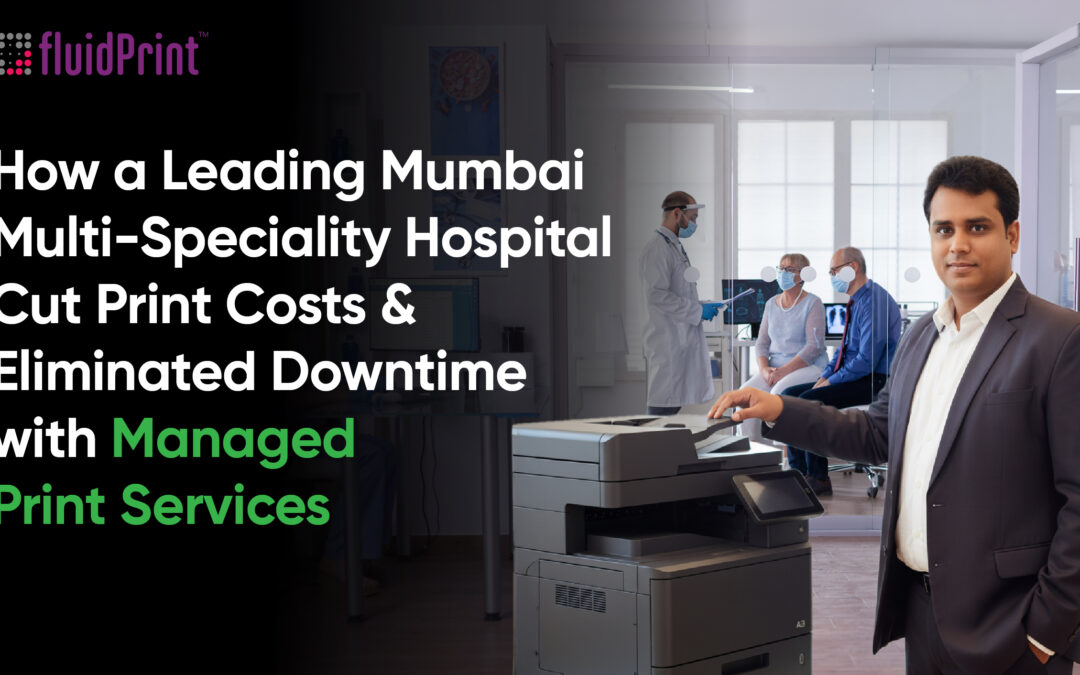
A 7,000-user A-category corporate hospital was grappling with a complex print fleet across 400+ printers from three different OEMs, which impacted cost control, uptime, and operational efficiency. Here’s how a single, governed Managed Print Services (MPS) engagement with Wepsol turned the fragmented print estate into a controlled, predictable, audit-ready service without disrupting a single day of patient care.
The Numbers at a Glance
COST OPTIMIZED
LESS DOWNTIME
ROI ACHIEVED
COMPLIANCE
The Customer: Healthcare That Never Stops
In a hospital, a printer is rarely just a printer. It delivers the patient’s discharge summary, the labelling of critical medication, the consent form before surgery, and even the insurance pre-authorization that decides when a patient is admitted. When printing stalls, patient care stalls along with it.
Serving over 7,000 users across clinical, diagnostic, and administrative functions, this leading A-category multispecialty hospital in Mumbai had a print infrastructure that had grown organically over the years—resulting in increasing complexity, limited visibility, and mounting operational challenges. This case study explores how Wepsol helped bring control, predictability, and governance to this critical business function.
Environment at a Glance
- 7,000+ users across a multi-building Mumbai campus
- 432 printing and imaging devices in active use
- ~1,200,000 (1.2 million) pages printed every month
- Three separate OEMs in the fleet: Canon, HP and Epson
- Two different service vendors, with no single point of accountability
The Challenge: A Fragmented, Expensive, Opaque Print Estate
A comprehensive print audit conducted by Wepsol before deployment uncovered an environment whose true costs extended far beyond its monthly spend. While the hospital was incurring approximately ₹6–7 lakh per month on printing, equating to an average cost of nearly ₹0.30 per page. The seemingly efficient cost structure in reality concealed a fragmented ecosystem plagued by hidden operational overheads.
Key Findings of the Audit
- ~15% device downtime, with breakdowns interrupting clinical and back-office workflows
- ~5% cost leakage driven by uncontrolled and duplicate printing
- Overlapping vendor responsibilities, creating operational bottlenecks and slower issue resolution.
- Manual document processes persisting in nearly 10% of workflows, reducing efficiency.
- Limited fleet visibility with no real-time view of utilization, costs or device performance.
- Potential compliance vulnerabilities, stemming from inadequate controls around sensitive documents.
The real cost was never the per-page rate.
In a healthcare environment, a 15% downtime is not simply an IT inconvenience; it is a patient experience, operational continuity, and compliance concern. Print leakage, manual interventions, and limited visibility were quietly driving the true cost of every printed page far beyond the nominal £0.30 benchmark.
The Wepsol Solution: One Partner. One Platform. Total Visibility.
Wepsol proposed a centralized Managed Print Services model powered by fluidPrint, designed to bring governance, predictability, and operational control to the hospital’s print ecosystem. The objective was not merely to reduce costs, but to eliminate inefficiencies, minimize risk, and ensure that every rupee spent on printing translated into measurable business value.
What Changed?
- Optimized Device Strategy
The fleet was rationalized and right-sized, aligning A4 device deployment with actual print demand rather than legacy procurement patterns. - Predictable Cost Structure
A Single Cost-Per-Copy (CPC) model was introduced, covering devices, consumables, maintenance, and support—transforming printing into a transparent and consumption-driven service. - Document Management System (DMS) integration
Document Management capabilities enabled scan-to-workflow processes for medical records, claims processing, and approval cycles, reducing manual intervention. - Proactive Service Delivery
Continuous remote monitoring and predictive maintenance ensured that device health, toner levels, and potential faults were addressed before impacting operations. - Centralized Fleet Management
A unified dashboard provided real-time visibility into print volumes, utilization patterns, cost allocation, and service performance (SLA) across the campus. - Single-Partner Accountability
Multiple service providers were consolidated into one accountable partner, supported by a committed 6-hour response SLA, simplifying support and accelerating issue resolution.
Implementation: 60 Days, Zero Disruption
Healthcare operations cannot afford downtime. The transformation was therefore executed through a carefully phased approach, ensuring uninterrupted access to printing, scanning, and document workflows across clinical and administrative functions.
- Phase 1 (Days 1–30): Audit validation, pilot deployment, and workflow redesign to establish the foundation for a standardized print ecosystem.
- Phase 2 (Days 31–60): Enterprise-wide rollout, fleet consolidation, and Document Management System (DMS) activation across the campus.
- Change Enablement: 15 structured training sessions equipped users to adopt secure print and scan-to-DMS from day one.
The Results: Measurable, Audited, Sustained
The impact was immediate and measurable. What began as a print optimization initiative evolved into a fully governed print ecosystem—delivering improved uptime, stronger controls, greater visibility, and a more predictable cost structure.
| Metric | Before Wepsol MPS | After Wepsol MPS |
|---|---|---|
| Monthly print spends | Rs. 6–7 lakh | 10% optimised |
| Device downtime | 15% | 7% |
| Service vendors | 2 | 1 (single SLA) |
| Device count | 432 | ~10% reduced |
| Process automation | ~10% | 100% |
| Print volume control | Uncontrolled | 20% improvement |
| Security compliance | Limited | 100% |
| SLA response | Undefined | 6 hours |
Most importantly, the hospital transitioned from managing printers as individual assets to governing printing as a strategic service—one designed around uptime, accountability, security, and operational continuity.
The Headline Outcomes
✓ 10% Cost Optimization through better governance—not reduced usage.
✓ 50%+ Reduction in Downtime, protecting continuity of care.
✓ 10% Smaller Fleet, Greater Efficiency through rightsizing.
✓ 100% Automated. 100% Compliant.
✓ Return on investment in under 20 months on a ₹5 Cr / 5-year engagement.
What The Hospital Really Bought?.
Not 432 printers, but 10% lower total cost, centralized control, stronger compliance, and uninterrupted access to mission-critical documents. Because in healthcare, printing is not an IT function—it is an essential component of patient experience, clinical continuity, and operational excellence.
About Wepsol
Wepsol pioneered Managed Print Services in India and remains the country’s largest and most preferred MPS provider, twice recognized as India’s No. 1 MPS provider by IBC, USA. With over two decades of experience, 500+ enterprise clients, 2,000+ service locations, and more than 100,000 managed devices, Wepsol helps organizations move from fragmented, capital-heavy printing to a governed, pay-per-use service through its fluidPrint platform.
In regulated, document-critical environments like healthcare, that means one accountable partner for cost, uptime, security, and sustainability—so internal teams can focus on patients, not printers.
Frequently Asked Questions
1. How can costs drop if the monthly billing stays similar?
Because the headline rate was never the real cost. Eliminating roughly 5% leakage, cutting downtime, consolidating vendors, and removing redundant devices reduce the true cost of every productive page—which is where the 10% net optimization comes from.
2. Did patient care get disrupted during the rollout?
No. The 60-day implementation was phased so printing and scanning remained available throughout, with 15 training sessions easing staff onto secure release and scan-to-DMS workflows.
3. Is Managed Print Services suitable for other hospitals?
Yes. Any multi-location, high-volume, compliance-driven environment—hospitals, diagnostics chains, insurers—benefits from centralized governance, predictable CPC billing, and a single accountable partner.
Ready to see your own print estate clearly?
Wepsol begins every engagement with a fact-based print audit—the same discovery that surfaced this hospital’s hidden costs. Talk to Wepsol about a no-obligation MPS assessment for your organization.