



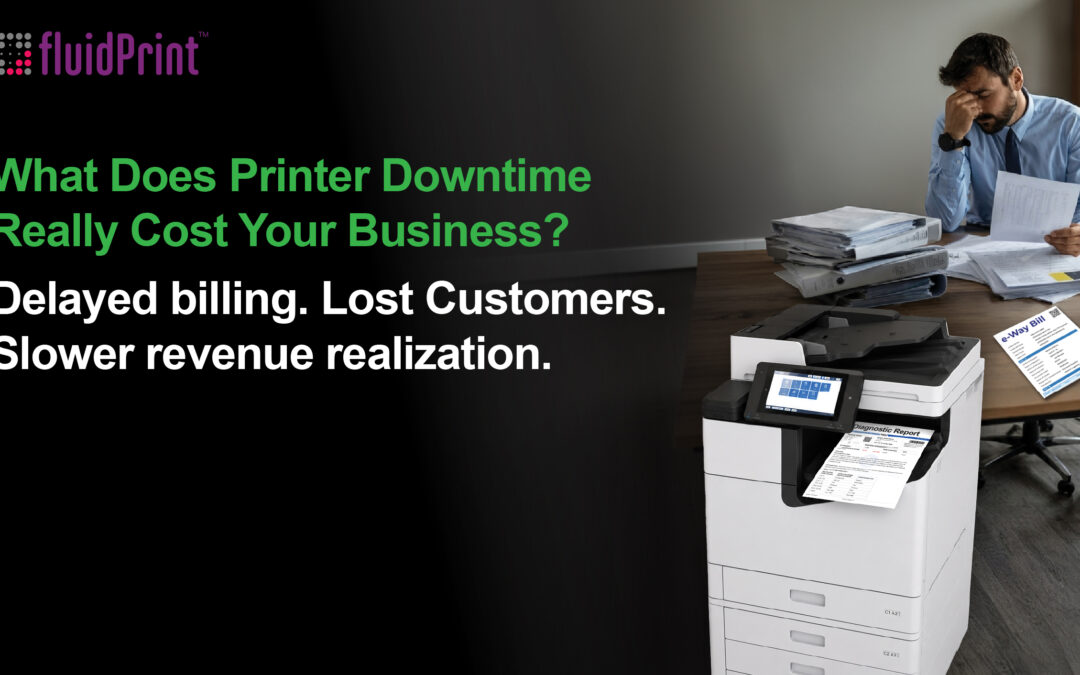
Most leaders can tell you exactly where their money leaks. Margins, attrition, bad debt, a shaky supply chain. Almost nobody points at the printer in the corner. It’s the one device in the building everybody forgets about, right up to the morning it stops and the billing counter goes silent, the dispatch dock starts backing up, and the invoices you were counting on are stuck behind a blinking error light.
If you ask a business leader about financial leaks, they are likely to point to shrinking margins, employee attrition, bad debt, or supply chain disruptions. Few consider the printers that produce invoices, statements, contracts, and other mission-critical documents that keep business operations moving until they fully go silent.
A printer ‘outage’ is usually a minor nuisance that the IT guy is expected to troubleshoot. But if this is a repeated occurrence with frequent paper jams and out-of-ink toners, halting workflows, and delayed billing cycles, that same footnote becomes a thunderous noise of dissatisfied customers and frustrated employees. That is the real printer downtime cost, and it hurts you in places nobody bothered to measure. The good news is that the right managed print services can close the gap before it ever opens.
We tend to file a printer outage under “minor nuisance.” A jam, a quick service call, a few sheets in the bin. But when you print on the critical path, meaning invoices, receipts, shipping labels, statutory paperwork, downtime stops being an IT footnote. It turns into late billing, frustrated customers, and revenue that arrives slower than it should. That is the real printer downtime cost, and it hurts you in places nobody bothered to measure. The good news is that the right managed print services close the gap before it ever opens.
The cost of printer downtime never lands on a single invoice
When a printer dies, the bill you can see is tiny. A repair charge, maybe a ruined ream. The expensive part hides everywhere else, which is exactly why the cost of printer downtime is so easy to underestimate.
The repair charges to fix a malfunctioning printer may be negligible, but its consequence in terms of employee experience is hidden. This is exactly why the cost of printer downtime is too easy to underestimate.
Physical documents remain essential for regulatory compliance, audit readiness, and routine business operations. In industries such as banking and healthcare, the inability to print invoices, transaction records, or patient documents, affect service delivery. Over time, these delays can translate into lost productivity and deferred revenue.
Take the instance of a billing desk that suddenly can’t print invoices. Every minute it’s down, transactions stack up, customers wait, and money you should already have booked just sits there. In a busy retail floor, a hospital, a bank, a logistics yard, one hour of business printer downtime can freeze hundreds of transactions. You don’t lose that revenue forever, but you delay it, and delay has a price.
There’s a quieter drain too. The second the printer quits, people stop doing their real jobs and start playing technician. They ring IT. They sit on hold with a vendor. They work around it, carrying documents to another floor, another building, another machine that still works. Stretch a 45-minute outage across a dozen people, a few times a month, and you’ve quietly torched hundreds of paid, productive hours a year on a problem that never even made it into a ticket.
The hidden cost of printer downtime rarely appears on a balance sheet. It is absorbed by employees and IT teams who are forced to step away from their primary responsibilities to troubleshoot devices, manage service calls, or coordinate with vendors. What seems like a routine 30–45-minute interruption can, when multiplied across departments and repeated over time, translate into a meaningful erosion of productivity and operational efficiency.
And the costliest one is the one you’ll never trace. The customer who waited too long at the counter. The buyer whose delivery ran late because the label printer was down. They don’t file a complaint. They just don’t come back. You won’t find them on a report, but you’ll feel them later, in churn and in shrinking lifetime value.
The most expensive consequence of printer downtime is often invisible. Customers seldom complain about delayed invoices, longer wait times, or postponed deliveries—they simply adjust their perception of the service they receive. These incidents may never appear in operational reports, yet their cumulative impact can be felt in declining customer retention and reduced lifetime value.
When a printer quietly becomes business-critical?
Not all printing carries the same business impact. A delayed marketing brochure may be an inconvenience, but a significant portion of enterprise printing sits directly in the path of revenue generation, customer service, and compliance.
Invoices and receipts enable transactions to be completed. Barcode and shipping labels keep inventory moving through the supply chain. Statutory documents support regulatory compliance, while contracts formalize business commitments. In healthcare environments, prescriptions and patient records are integral to delivering timely care. In each of these scenarios, a printing failure is more than a device issue—it disrupts a critical business process, delays outcomes, and can have tangible operational and financial consequences.
That’s the part most organisations miss. Business-critical printing deserves business-critical management. We fuss endlessly over server uptime, network redundancy, database failover, then leave the print fleet entirely to luck and react only after a failure has already tripped up the business. That reactive reflex is exactly why the cost of printer downtime climbs so fast, and it’s precisely what proper printer fleet management is built to prevent.
The reactive trap that keeps printer downtime cost high
Most companies manage printers by waiting for them to break. A device fails, somebody eventually notices, a ticket goes up, a technician turns up hours later, a part gets ordered, and somewhere in that long chain, productivity quietly drains away.
Emergency repairs, rush-ordered parts, last-minute callouts cost far more than planned maintenance ever would, sending your quarterly budget into an uncontrolled spin. Without real print cost reduction in place, your operating spend becomes a run of unpleasant surprises instead of a steady number you can actually plan around.
A growing business might run multiple printers spread across different sites. No internal IT team can collaborate to maintain that many devices, let alone predict the output from depreciating printer assets. The device complexity outruns the headcount, and the small problems pile up into big ones. This is the exact point where structured printer downtime management stops being optional.
Reduce printer downtime by fixing the process, not just the machine
The answer isn’t a high-end printer but rather setting in place better a process, one equipped to prevent failures at the very outset instead of mopping up afterwards. That’s the whole idea behind serious managed print solutions.
The methods deployed by managed print providers are simple and effective. Remote monitoring that keeps an eye on every device in real time monitors toner levels, error rates, jams, and worn consumables, which are some early warning signs of something about to give way. The moment a device starts drifting toward trouble, it gets flagged, and a technician steps in before it goes down. Consumables get topped up before they run dry. Parts get swapped before they fail. And when someone does need to be there in person, nationwide on-site support means help reaches the device fast, wherever it happens to sit. That combination is how you genuinely reduce printer downtime rather than just react to it.
What you end up with is a completely different relationship with your print setup. Firefighting gives way to predictable uptime. Surprise emergency bills give way to optimised, forecastable OPEX. Interrupted operations give way to business continuity. The fleet stops springing nasty surprises on you and turns invisible in the best possible way, just quietly working every time someone hits print. That is what good print management solutions are supposed to deliver.
Why enterprises pick Wepsol for managed print services?
The case for handing print to a specialist comes down to a few things an internal team struggles to pull off on its own.
Trust at Scale: Multiple Nifty 50 companies—the kind of organizations with the least tolerance for disruption and the highest expectations for service continuity—rely on Wepsol to manage their print environments.
Operational Expertise: Wepsol manages over 22,000 printers across 250+ enterprises. Operating at this scale creates capabilities that are difficult for in-house teams to replicate: deep fleet intelligence, proactive issue identification, optimized consumables logistics, and print management expertise developed through managing thousands of devices every day.
Service Accountability: Reliability should be measurable, not assumed. Wepsol delivers 99%+ SLA-backed uptime, transforming service commitments into performance metrics that enterprises can track and hold providers accountable for.
Enterprise Credibility: As a BSE-listed company, Wepsol operates with the discipline of public-market governance, financial transparency, and strong operational controls—an important consideration when entrusting a partner with business-critical infrastructure.
Expertise in Mission-Critical Environments: Some industries cannot afford print disruptions. Banking, healthcare, government, and utilities operate under stringent compliance requirements where a printing failure can impact customer experience, delay essential processes, or create regulatory exposure. Wepsol’s managed print services are specifically designed to support these highly regulated and mission-critical environments, ensuring security, uptime, and operational continuity.
The problem was never really the printer
The strongest partners go beyond print and into the pain points sitting right next to it. One provider offering managed print solutions, managed IT services, and a smart GST platform pulls a messy spread of vendors into a single accountable contact. Less overhead, simpler governance, and systems that finally talk to each other instead of working in silos. Real print cost reduction usually starts here, with consolidation rather than another point fix.
Because honestly, the printer was never the real issue. The real issue is operational fragility, the slow build-up of small, unmanaged dependencies, each one quietly capable of knocking revenue off course. Treating print as part of a proper operational strategy, rather than a one-off purchase, is what separates the businesses that stay standing from the ones that wobble.
The bottom line on printer downtime cost
Printer downtime is one of the most underrated operational risks going. Its costs are real but well disguised: delayed billing, stalled revenue, wasted hours, customers who slip away without a word. These challenges persist because print environments are still largely managed through reactive maintenance models rather than proactive, data-driven approaches.
The way out is a change of model, from reactive repair to proactive, monitored, professionally run print management solutions. Remote monitoring catches trouble before anyone feels it. Nationwide on-site support handles what can’t be sorted remotely. SLAs make reliability something you can measure. And a credible partner operating at scale turns an unpredictable cost centre into a steady, optimized one through disciplined printer downtime management.
The real question was never whether you can afford managed print services. It’s whether you can keep absorbing the silent, compounding printer downtime cost of doing without them. Business-critical printing deserves business-critical management, and the companies that grasp that are the ones still billing on time, still keeping customers happy, and still seeing revenue flow without the interruptions everyone else writes off as normal.
Powering Predictable Workplaces. End-to-End.
To secure predictable uptime for your print environment, reach Wepsol at +91 99458 24840 or visit www.wepsol.com.