



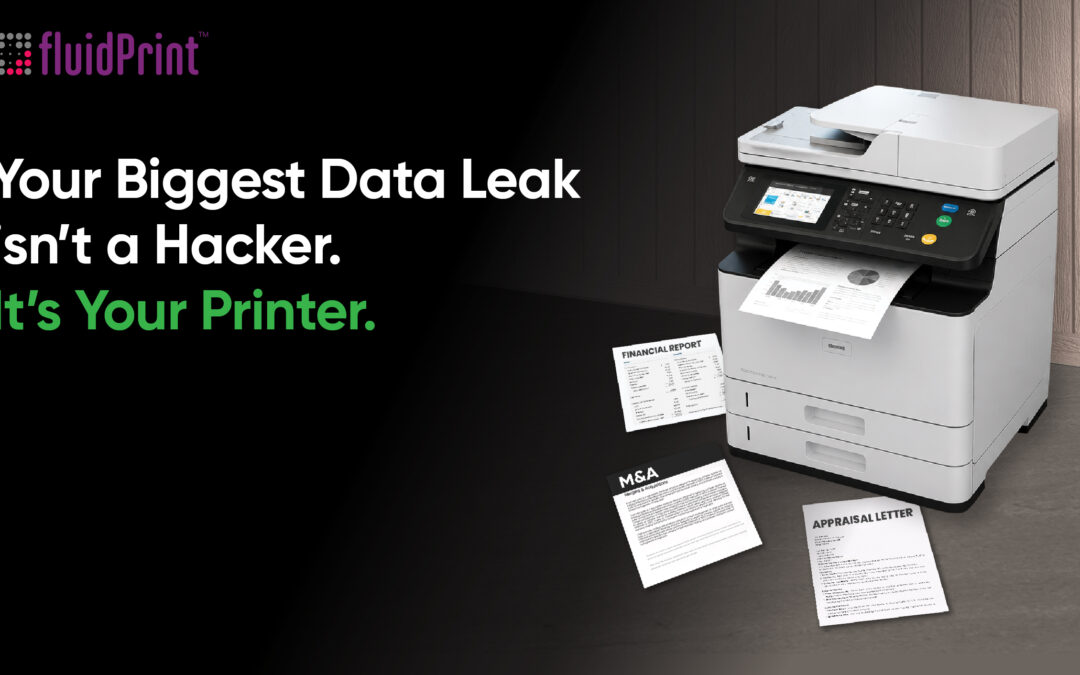
Ask a roomful of executives to picture a data breach, and you’ll get the same image every time — a hacker in a hoodie, green code scrolling down a black screen, an attack from somewhere far away. That image consumes most of the IT budget, defending against external threats: the Firewalls, endpoint protection, threat intel, even a security team awake at 3 a.m. watching dashboards.
Meanwhile, sensitive documents slip out right through the door every single day through a device nobody bothered to lock down. It’s not hidden in a server room. It’s standing in plain sight – in the corridor, by the pantry, on every floor – it’s the office printer. Yet, any kind of printer security is overlooked and quietly but easily becomes the weakest link in organisations, including those that have already deployed managed print services.
The leak is sitting in plain sight
Picture the most ordinary thing in any office. Someone hits print, then gets drawn into a chat with a colleague, takes a customer call, stops to get some coffee on the way – meanwhile the document’s already printed, lying face up in the tray, where anyone walking past can read it, pick it up, or snap a photo.
Now think about what that page could actually be about – an appraisal letter with salary hike and additional perks or a financial docket with numbers that aren’t public yet. Even worse if it’s an M&A document the company is legally bound to keep confidential. The list is endless – a board document, a patient’s medical report, a client’s case file, patents. These aren’t freak occurrences — they’re the documents that move through enterprise printers every hour of every working day.
And here’s the part that should bother you: you’ve almost certainly seen pages like these yourself, sitting unattended at a printer. If you’ve seen them, so has everyone else who walked past. This isn’t a mere vulnerability waiting for some clever attacker. It’s insider information that can cause irreparable damage to reputation and revenues — and it’s exactly the kind of printer security risk that secure document printing is meant to eliminate.
The breach that never gets counted
What makes this so sneaky is that it leaves no trace and trips no alarm.
When someone breaches your network, there are logs, alerts, a forensic trail, eventually leading to a post-mortem. When a confidential document gets read by the wrong person at a printer tray, there’s no alert. No log. Nobody even knows it happened. The information was seen, maybe photographed, and the page either got collected by its owner or slipped back into the tray. The leak’s done, and it’s untraceable till the damage is done.
That’s why printer exposure almost never shows up in breach statistics, and why it is underrated. Security teams measure what they can detect, so an unmonitored printer becomes a blind spot in an otherwise tight data leak prevention strategy. But the documents involved — pay data, financial figures, strategy, medical records — make the damage every bit as real as a network intrusion, and a lot more personal. For anyone in finance or healthcare, that’s a compliance problem wearing the disguise of an everyday inconvenience.
You can’t fix this with a memo
The reflex is to blame the employee. Tell people to grab their printouts faster. Send a memo. Run an awareness session. Stick a poster on the wall by the printer.
This never works, and the reason is simple: it asks human behaviour to be flawless, withstand temptation every time, forever. People will always get distracted. They’ll take the call, answer the urgent message, or just forget. Expecting perfect discipline from thousands of busy people across hundreds of print jobs a day isn’t a security control. It’s a hope. And hope isn’t a strategy.
In this instance the flaw in the process can very easily be rectified by simply deploying secure print solution. In normal printing, the page hits the tray the instant it’s sent — whether or not the person who sent it is standing there. That gap between “print” and “collect” is where every leak lives, and no amount of training closes it reliably. So you change the process. That’s the whole premise behind serious secure print management.
Print only when you’re standing there
The fix is structural, and it’s almost embarrassingly simple. The document shouldn’t print at all until the person who owns it is physically at the machine, ready to take it. The industry term for this is secure print release, and it’s the single most effective best practice for printer security that an enterprise can adopt.
That’s exactly the control Wepsol builds into fluidPrint – it is a secure, subscription-based managed print service. Sensitive documents are released only when the authorised employee authenticates right at the printer — a secure PIN or password, at the moment of collection. Until then, the document isn’t paper. It waits, held securely in the queue. No unattended printout, because nothing prints into an empty corridor.
The effect on the whole problem is total. The appraisal letter can’t sit in the tray, because it never reaches the tray until the right person’s there. The financial docket can’t be read by a passer-by, because it isn’t produced until the authorised employee authenticates. The M&A pages can’t be photographed by the wrong eyes, because they only appear in the hands of the one person entitled to see them. The gap where every leak used to live just stops existing.
Security where it actually happens
This is what “control at the point of access” really means. Security gets enforced not by policy, nor by reminders, nor hope — but at the exact spot and second where a document turns into something tangibly readable. With secure printing in place, the printer stops being the soft underbelly of your information chain and becomes a controlled checkpoint.
And it slots into how people already work. Nobody has to learn some baffling new system or overhaul their habits. They send documents the way they always have. The only change is a quick authentication at the device before the page appears. Good security works because it doesn’t rely on people being exceptional. It makes the safe path the default path, which is precisely why modern print management solutions build secure release in as standard rather than as an add-on.
Why is this sharper now than ever?
The stakes around document confidentiality keep climbing. Data-protection rules are tightening, and what enterprises owe in safeguarding sensitive information is getting stricter by the year. A salary slip or a patient record read by the wrong person isn’t just awkward — it can be an actual compliance failure.
The sectors where this bites hardest are the document-heavy ones. Banks handling financial and personal data. Insurers sitting on claims and policyholder records. Diagnostic labs and hospitals holding sensitive medical results. Law firms guarding privileged case files. Manufacturers protecting commercial confidentiality. In every one of these regulated, high-stakes environments, weak printer security isn’t a small oversight — it’s an open door in an otherwise locked building. These are exactly the sectors Wepsol’s managed print services are built for, from finance to healthcare to legal.
A partner you can actually trust
Operating as Wep Solutions Ltd, the company has spent over two decades on workplace technology, and it delivers secure printing through its fluidPrint managed print service. fluidPrint is built to be elastic, secure and subscription-based, with secure print release sitting at the heart of how it protects sensitive documents.
The client list is the part that should reassure a security or compliance lead. Wepsol manages print for organisations where confidentiality is non-negotiable — HDFC Bank in financial services, KIMS Hospitals in healthcare, alongside enterprises like Wipro, Hyundai, UIIC and MRF. These are precisely the regulated, document-heavy environments where an unsecured tray is a genuine liability, and they’re the sectors fluidPrint is designed around. Wepsol has even published its own thinking on why secure print solutions are a necessity for the financial sector and why diagnostic-centre report printing has to be both fast and safe — a sign it treats this as a core requirement, not an afterthought.
Put it together — secure print management at the point of access, proactive oversight of the whole fleet, and the accountability of an established, award-winning provider — and the printer flips from a liability into a controlled, trustworthy part of the business. That combination is what people are really after when they go looking for the best managed print services in India.
Where the real risk has been hiding
None of this means hackers don’t matter. Network security is worth every rupee it gets. But somewhere between the firewall and the front desk, a different kind of risk slips through — one no amount of network hardening was ever built to catch.
The point is that companies have been staring hard in one direction while a serious leak ran, unwatched, in the other. The most sophisticated perimeter on earth does nothing for a confidential page lying face up in a shared tray.
The only durable fix is to change the process so the exposure can’t happen in the first place. Print only when the right person’s there. Authenticate at the device. Close the gap completely. That’s how secure document printing turns the printer from your biggest data leak into one more part of the business you can actually trust.
Powering Predictable Workplaces. End-to-End. To secure your print environment, reach Wepsol at +91 99458 24840 or marcom@wepsol.com.