


And yet, here you are.
This is the IT trap that most growing startups walk into quietly. Not through bad decisions, but through the logic of doing things one at a time. Pick an antivirus, then figure out backup, then sort out remote support when the first hire calls in a panic from a client site. It feels manageable until it is not.
The Vendor Selection Problem Nobody Warned You About
The IT security & services market is not short on options. It is overflowing with options. There are hundreds of cybersecurity tools and vendors – each solving a small part of the problem. For any one category (endpoint protection, mobile device management, patch management, data backup), you are looking at dozens of credible options, each with different pricing models, different integration requirements, and different support structures. The real challenge is not availability. It’s integration, control, and accountability.
Take antivirus software as an example. The Indian cybersecurity market alone features solutions ranging from globally established names to locally hosted options, all of which are built in compliance with CERT-In requirements. To select the right one for your organization, you would need to:
- Understand whether your team primarily uses Windows, Mac, or mixed environments.
- Evaluate whether the solution integrates with your existing endpoint management tool.
- Compare licensing structures: per device, per user, or per seat.
- Check CERT-In compatibility & reporting capabilities under India’s 6-hour incident reporting mandate.
- Shortlist, evaluate through demos & solution walkthroughs, and validate capabilities before committing to them.
And this entire exercise – the research, comparisons, and evaluations – is just to arrive at one decision: your antivirus.
You still have ransomware protection, data loss prevention, patch management, remote support, and asset tracking to solve. Each one is its own selection exercise, its own vendor relationship, and its own renewal cycle.
The question is not whether you can do this. It is about whether this is where your time and attention should go.
What This Actually Costs You
The obvious cost is time. But the less visible impact is quality. When you evaluate each tool independently, you are not building an IT stack. You are building a patchwork. And patchworks have gaps.
Consider a scenario that plays out more often than most startups admit publicly: a company’s antivirus is from one vendor, its backup is from another, and its remote management tool is from a third. When a ransomware incident hits, and cybersecurity incidents in India rose from 10.29 lakh in 2022 to 22.68 lakh in 2024, the three vendors each point to the other two. There is no single owner of the incident. Recovery is slow, expensive, and chaotic.
This is not a hypothetical. It is the natural consequence of building your IT infrastructure vendor by vendor, without a unified architecture underneath.
8 Signs Your Business Is Already in the Trap
Most startups do not realize they are in this situation until a problem surfaces. By then, the gaps between tools have compounded. The image below captures the eight most common signals that a fragmented IT setup has started working against the business rather than for it.
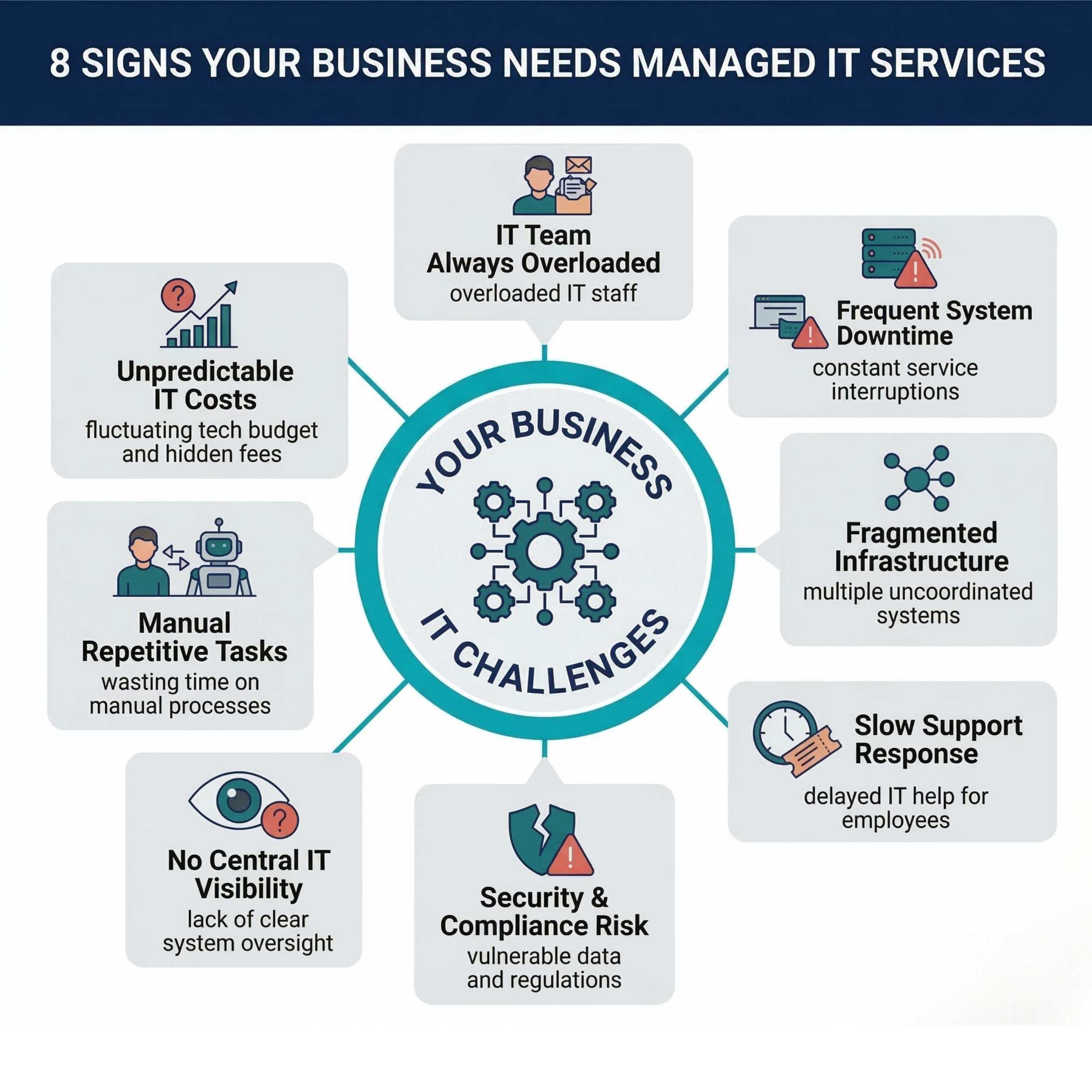
Your Business IT Challenges at a Glance
If your IT team is always overloaded, your systems go down without warning, your infrastructure runs on multiple unconnected tools, or your employees wait too long for support, these are not isolated inconveniences. They are structural symptoms of an disconnected approach that has outgrown your team’s capacity to manage it.
Security and compliance risk is particularly acute for Indian startups. CERT-In’s 6-hour incident reporting mandate, combined with rising cyberattack volumes, means there is no room for a setup where no single team member has full visibility across endpoints, backups, and network activity. No central IT visibility and manual repetitive tasks only make that exposure worse.
The last two signals on the list, unpredictable IT costs and fragmented infrastructure, connect directly to what the next section covers: what this approach is actually costing you in rupees, not just in hours.
Your Employees Are Also Part of This Equation
A fragmented IT setup does not just affect your infrastructure team. It affects every person in your organisation.
When an employee has a device issue, who do they call? If the answer is ‘it depends on the issue,’ that is a problem. If the helpdesk is only available during working hours and your team works across time zones, that is an even larger problem. If there is no formal response time commitment, your employee spends their working hours waiting, and your customers end up absorbing the downstream impact.
Deloitte’s research found that 86% of IT leaders consider employee experience critical to organisational success (Deloitte Global Human Capital Trends). Startups often assume they are too early to care about this. That is a dangerous assumption. The habits you set in your first 50 hires become the culture you carry into your next 500.
A managed IT package solves this by design. Every device enrolled in the package has the same baseline protection, the same support access, and the same monitoring. There is no variation between what the founder’s laptop gets and what the newest hire in the operations team gets.
The Control Problem Startups Do Not See Coming
Here is the other side of the equation that does not get discussed enough: employee access and control.
As your startup grows, you will have employees who try to install software outside your approved list. You will have people connecting to unsecured Wi-Fi with company devices. You will have quitters who walk out with access to systems they should no longer be able to reach. These are not security nightmares reserved for large enterprises. They happen at ten-person companies.
A package-based managed IT approach comes with built-in controls. Endpoint detection, remote wipe capability, patch enforcement, and access management are part of the package, not optional add-ons you negotiate into three separate vendor contracts six months after you needed them.
Your employees get responsive, reliable IT support. Your organisation gets the control layer it needs to operate securely. Both needs are met in a single cost line.
What the Numbers Actually Look Like
It may seem cheaper to build IT one piece at a time – until you actually compare the costs.
When you factor in the time spent on vendor evaluation, the overlap in tool licensing, the gaps in coverage between tools that were not designed to work together, and the cost of a single unresolved incident, the per-device monthly cost of a managed package consistently comes out lower.
Research from CompTIA shows that managed IT services reduce overall IT costs by 24-40% compared to equivalent in-house or self-assembled capabilities. The bigger saving is not always in the subscription fee. It is in the hours your team stops spending on IT procurement, coordination, and firefighting.
| What you need | Unbundled approach | Starter Package approach |
|---|---|---|
| Endpoint protection | 1 vendor, 1 contract, 1 renewal | Included |
| Ransomware protection | Separate tool or add-on | Included |
| IT helpdesk support | Ticket with each vendor separately | Single point of contact |
| Asset & patch management | Separate tool, separate admin | Included |
| Data backup | Separate vendor, separate billing | 5 TB pool included |
| AI-based IT automation | Enterprise tool, high license cost | Included |
| Cost per device/month | Variable, often ₹800 – ₹1,500+ when aggregated | Starts at ₹499/device/month |
The Simplest IT Decision You Will Make This Year
You have already seen what the patchwork approach costs: vendor blame-shifting during incidents, unpredictable monthly bills, employees waiting on support that was never designed to be fast, and a security posture built on gaps between tools that were never designed to work together.
The decision is not complicated. One package. One cost line. One team is accountable for every device, every incident, and every renewal.
FluidTrust package enables your business to have 24×7 IT support, endpoint protection, automated patching, asset management, & 5 TB of backup, starting at ₹499 per device per month. No integration headaches. No renewal juggling. No incident with three vendors pointing at each other.
Your team deserves IT that is always on and that works every time they need it. Your business depends on it.
Frequently Asked Questions
What is fluidTrust and how is it different from regular IT support?
fluidTrust is a structured IT Governance and Control Plane built within the fluidPro framework by Wepsol. Unlike traditional IT support that reacts to issues after they occur, fluidTrust focuses on building measurable control across five areas – security discipline, operational stability, compliance documentation, scalability readiness, and dependency risk. The goal is to move businesses from assumed control to verified, structured governance.
How do businesses usually discover they have lost control of their IT environment?
Most businesses discover IT governance gaps during high-stakes moments – a funding due diligence discussion, a security incident, a key IT resource’s sudden resignation, a compliance review, or a major system outage. These events expose blind spots that were never visible during normal operations: backups that fail during restoration, misconfigured security tools, undocumented compliance practices, or access structures known only to one person.
What is the Self IT Assessment / IT Heat Map and who is it for?
The Self IT Assessment / IT Heat Map is a structured baseline tool designed for founders and leadership teams – not technical staff. It helps decision-makers quickly assess their governance maturity, security posture, operational visibility, compliance readiness, and scalability alignment. It is not a technical audit. It provides clarity on where the organization stands before any formal engagement with fluidTrust begins.